
5 Proven Strategies to Boost Arithmetic Fluency in Primary School (and How Primary Arithmetic Makes It Easy)
- Primary Resources Hub

- Sep 8, 2025
- 3 min read




Estimated reading time: 6 minutes
Audience: Teachers, maths leads, and parents of children aged 5–11
Key take‑away: A simple weekly rhythm of explicit teaching, daily practice and low‑stakes assessment can transform calculation confidence – and you don’t have to reinvent the wheel.
Why Arithmetic Fluency Matters
The 2025 KS2 SATs devoted a full 30‑mark paper to pure arithmetic, rewarding pupils who can add, subtract, multiply and divide accurately under time pressure. Meanwhile, Ofsted’s latest mathematics subject report highlights that the most successful primary schools “revisit number facts frequently until knowledge is automatic”.
Yet many teachers still juggle multiple schemes and ad‑hoc quizzes to keep fluency ticking over. Below are five evidence‑informed strategies you can embed straight away, plus practical tips for doing it with Primary Arithmetic.
1. Make Arithmetic Practice a Daily Habit
Short, focused bursts (5–10 minutes) outperform occasional long sessions because they exploit the spacing effect – our brains remember more when learning is revisited little and often. The NCETM’s Mastering Number programme uses this principle to great effect in EYFS and KS1.(ncetm.org.uk)
Do it tomorrow
Start every maths lesson (or even morning register) with three quick calculation questions.
Use the skill of the week from Primary Arithmetic as your prompt so pupils see immediate relevance.
2. Teach Calculation Strategies Explicitly
The Department for Education’s Mathematics Guidance stresses that pupils need clear models and worked examples before independent practice.(assets.publishing.service.gov.uk) Anchor new strategies with concrete–pictorial–abstract (CPA) representations and precise teacher language.
With Primary Arithmetic
Each test sequence tells you exactly which method to teach (e.g. “Subtract near multiples of 100”) and supplies exemplar questions, saving you planning time.
3. Use Low‑Stakes, High‑Frequency Assessment
Weekly quizzes provide timely feedback without the anxiety of termly mock SATs. They also guard against the illusion of competence – when pupils think they can do something until asked to prove it.
Primary Arithmetic in action
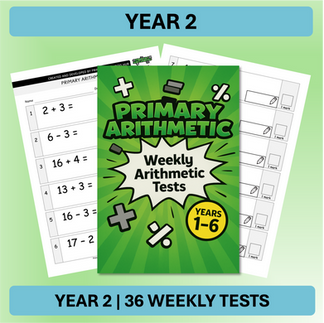
36 bite‑size tests a year (roughly one per week).
Age‑appropriate timings (from 5 minutes in Year 1 to 30 minutes in Year 6).
SATs‑style layout builds familiarity and exam resilience.
4. Close Gaps Quickly with Targeted Intervention
Assessment is only powerful when it drives teaching. After each quiz, log results in the built‑in formative assessment tool: one click generates skill‑specific groups and suggested follow‑up tasks.
Two or three 10‑minute “fix‑it” sessions early next week can prevent misconceptions from bedding in.
Celebrate micro‑gains – moving from 6/20 to 9/20 is real progress.
5. Build a Culture of “Number Talk” Beyond the Maths Hour
Arithmetic isn’t confined to the classroom clock. Encourage children to explain methods, quiz each other, and spot maths in the real world (the till receipt, a bus timetable, a football score).
Ideas for home–school links
Send a Friday Family Challenge featuring two questions that mirror the week’s focus skill.
Host a “Calculation Coffee Morning” where pupils teach parents the latest strategy – a powerful confidence booster.
Ready to put these ideas into practice?
Primary Arithmetic weaves all five strategies into a single, easy‑to‑run package:
Clear progression from Year 1 - 6 aligned with the National Curriculum.
Weekly rhythm that fits into an existing lesson slot.
Data‑driven feedback so you teach the pupils in front of you, not the scheme.
Try it for free: Download a sample pack of tests and the assessment tracker, or drop us a line at support@primaryresourceshub.co.uk to arrange a whole‑staff demo.
“Since adopting Primary Arithmetic our average KS2 arithmetic score has jumped by 10 marks, and pupils talk about number with genuine confidence.”— Maths Lead, Oakdale Primary School
Final thought
Arithmetic mastery isn’t about cramming before SATs. It’s the cumulative effect of hundreds of well‑designed, low‑stakes encounters with number. Implement the five strategies above – and let Primary Arithmetic do the heavy lifting – and you’ll see sharper, speedier calculators across your school.


Comments